Swapping the KE's hotend: 22 mm3/s, and the pressure advance value you have to re-derive
A high-flow hotend on the KE raises the volumetric ceiling from about 11 to 22 mm3/s and cuts a typical print from 108 minutes to 67. It also invalidates every pressure advance value you had, and this log is mostly about that second consequence.
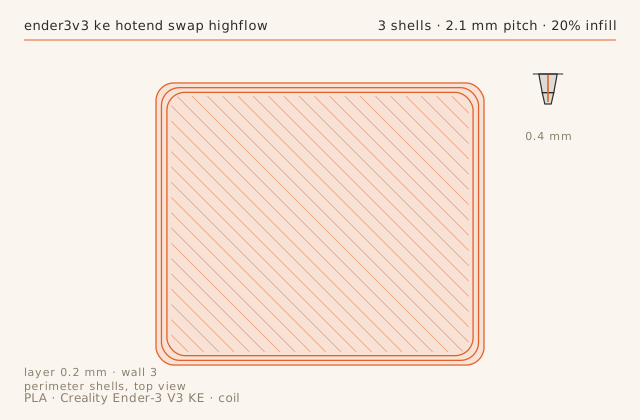
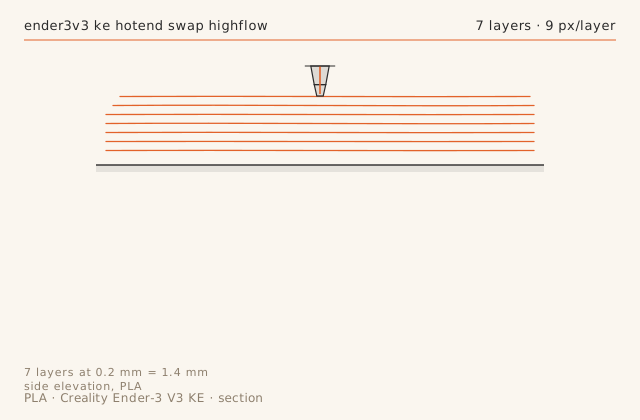
Slice diagramsDrawn from this entry’s own slicer settings.
Print record
- Machine
- Creality Ender-3 V3 KE
- Material
- PLA
- Nozzle
- 0.4 mm
- Layer height
- 0.2 mm
- Walls
- 3
- Infill
- 20%
- Print time
- 1 h 7 min
- Published
- October 19, 2026
Do the cold pulls before you tune anything
A new hotend arrives with a small amount of machining debris and assembly residue in the melt zone, and it will produce inconsistent extrusion for the first 15 mm of every print until it is out. Three cold pulls at 95 C followed by a 150 mm purge removed it completely on this machine. Skipping this step means tuning pressure advance against a moving target.
This is the single most common reason people swap a part and conclude the new part is worse. Clean it, then measure it.
Melt zone length is what makes the speed possible
The stock hotend could sustain about 11 mm3/s before under-extruding; the replacement held 22 mm3/s with a 0.4 mm nozzle. At 90 mm/s of outer wall and 200 mm/s of infill, a 40 mm part that took 108 minutes now takes 67. The gain is not from the motion system, which was already capable, but from the melt rate.
Watch the print's actual flow demand rather than the speed number. At 0.2 mm layers, 0.42 mm line width, 200 mm/s infill demands about 16.8 mm3/s, which is inside the new ceiling with headroom for the solid infill layers.
Re-derive pressure advance, do not scale it
Pressure advance compensates for the pressure that has to build and decay in the melt zone at each corner. Lengthen the melt zone by 12 mm and the decay takes longer, so the correct value falls. On this machine it went from 0.042 to 0.031 — a 26 percent change that produced visibly ballooned corners until it was corrected.
Print a pressure advance tower after any hotend change, any nozzle change and any change of filament diameter. It takes 14 minutes and it is the setting most sensitive to hardware.
Retraction goes up for the same reason
Retraction had to rise from 1.2 to 1.6 mm, because the longer melt zone means more filament has to be pulled back to break the tail at the nozzle. Going further, to 1.8 mm, started producing partial clogs. The window moved; it did not disappear.
Write both new values on the machine's maintenance card with the date. Any future diagnosis of stringing or blobbing starts from them rather than from the old profile.
Failure chainWhat went wrong, what was done about it, and what came out the other side.
-
Step 01
Symptom
After the hotend swap, corners ballooned and the seams had small bulges at 90 mm/s.
Fix
The new melt zone is 12 mm longer, so the pressure decays more slowly at a corner. Re-ran a pressure advance tower: 0.031 against 0.042 before.
Result
Corners sharp at 90 mm/s outer wall. Wall width unchanged at 0.41 mm.
-
Step 02
Symptom
Extrusion was inconsistent for the first 15 mm of every print after the change.
Fix
The new hotend had a small amount of assembly debris in the melt zone. Three cold pulls at 95 C, then a 150 mm purge.
Result
Consistent from layer one. Worth doing on any new hotend before tuning it.
Dimensional check
- Feature
- 40 mm flow test cube after the hotend swap
- Nominal
- 40 mm
- Measured
- 39.97 mm-0.03
- Tolerance
- ± 0.08 mm
- Note
- Pressure advance had to be re-tuned from 0.042 to 0.031 because the longer melt zone changes how the pressure decays at a corner. Wall width stayed at 0.41 mm.
Slicer profile
printer_model: Creality Ender-3 V3 KE 0.4, high-flow hotend
layer_height: 0.20
perimeters: 3
infill: 20% grid
perimeter_speed: 90
infill_speed: 200
accel: 4000
nozzle_temp: 218
bed_temp: 60
part_cooling: 100%
pressure_advance: 0.031
retraction: 1.6 mm at 35 mm/s
max_volumetric_speed: 22 mm3/s
What carried over
- Do three cold pulls on a new hotend before tuning; assembly debris causes inconsistent extrusion.
- The swap raised the usable ceiling from about 11 to 22 mm3/s and cut a 40 mm part from 108 to 67 minutes.
- Re-derive pressure advance after a hotend change; it fell from 0.042 to 0.031 here.
- Retraction moved from 1.2 to 1.6 mm; 1.8 mm started causing partial clogs.
Verdict
The high-flow hotend is a genuine improvement on this machine for functional parts, with the caveat that every flow-related value in the profile had to be re-derived.
Also on this machine Creality Ender-3 V3 KE
-
Print log
Z banding on the KE: an 8 mm period, then a 2 mm period, and two different fixes
Z banding has a period, and the period tells you the cause before you touch anything. This log works through two bands on the same machine — one at the leadscrew rotation period and one at the thread pitch — and shows why the first needed a mechanical fix and the second needed a software one.
- MaterialPLA
- Nozzle0.4 mm
- Layer height0.2 mm
- Print time58 min
- Failure chain2
-
Tune profile
TPU 95A on the KE's stock extruder: 3 hours 44 minutes and one very specific buckling point
The KE's Sprite extruder is direct drive, which makes flexible filament possible rather than easy. This profile is built around a 3.0 mm3/s ceiling that the machine will actually sustain, and it documents the one place where every failed attempt fails.
- MaterialTPU-95A
- Nozzle0.4 mm
- Layer height0.24 mm
- Print time3 h 44 min
- Failure chain2
-
Print log
Shimming the KE's bed: 0.15 mm of mesh error that compensation could not hide
Auto-levelling has a limit, and on a 0.28 mm first layer that limit is about 0.08 mm. This log covers a KE with a 0.15 mm low corner, the shim washers that fixed it mechanically, and the nine-position first-layer test that proves it worked.
- MaterialPLA
- Nozzle0.4 mm
- Layer height0.28 mm
- Print time41 min
- Failure chain2