TPU 95A on the KE's stock extruder: 3 hours 44 minutes and one very specific buckling point
The KE's Sprite extruder is direct drive, which makes flexible filament possible rather than easy. This profile is built around a 3.0 mm3/s ceiling that the machine will actually sustain, and it documents the one place where every failed attempt fails.
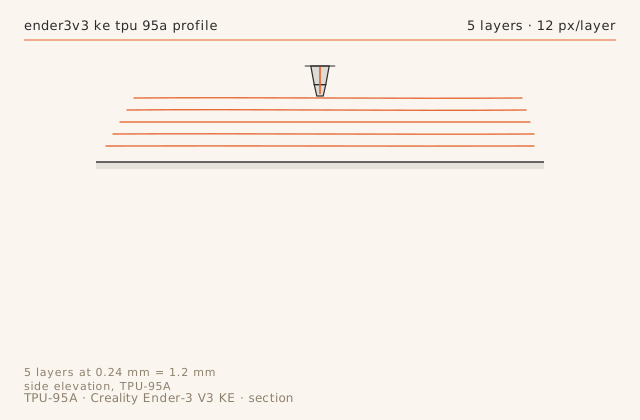
Slice diagramsDrawn from this entry’s own slicer settings.
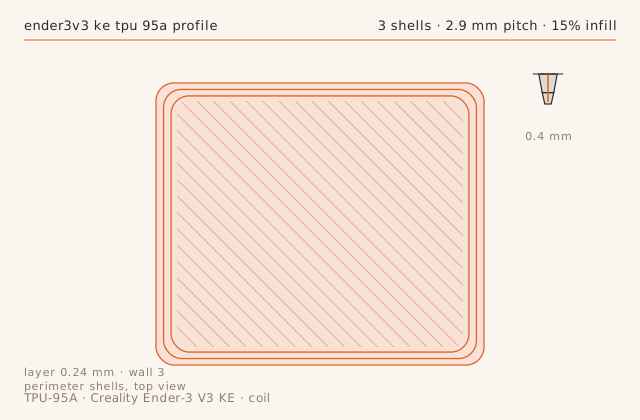
Print record
- Machine
- Creality Ender-3 V3 KE
- Material
- TPU-95A
- Nozzle
- 0.4 mm
- Layer height
- 0.24 mm
- Walls
- 3
- Infill
- 15%
- Print time
- 3 h 44 min
- Published
- October 2, 2026
There is one failure point and it is always the same
Every failed TPU print on this machine buckled in the same place: between the drive gears and the top of the melt zone, about 25 mm above the nozzle. That location tells you the problem is back-pressure rather than grip, because grip failures happen at the gears. The fix is always to lower the volumetric ceiling, not to loosen the latch.
At 4.5 mm3/s this extruder buckled reliably at around 90 minutes. At 3.0 mm3/s it printed for 3 hours 44 without a stall. On a direct-drive machine with a long melt zone, 3 mm3/s is close to the honest limit for 95A.
Turn the Z-hop off for flexible filament
Every standard profile has a z-hop on travel, and on TPU it does more harm than good. Lifting the nozzle with a soft filament in the melt zone stretches a thin thread on every move, and the threads are long and difficult to remove. Turning the hop off leaves small nozzle marks on the top surface instead, which come off with a fingernail.
The exception is a part with tall thin features where the nozzle would knock them over. In that case, keep the hop and accept the strings.
Over-extrude on purpose, but not too much
TPU relaxes after it leaves the nozzle, so a wall printed at 1.00 multiplier comes out thinner than the slicer expects and leaves gaps where perimeters meet. On this machine 1.05 closed the top surface completely; 1.08 produced visible blobs on the outer wall. The usable window is narrow — about 0.05 in multiplier — so change it in 0.02 steps.
Part cooling at 35 percent sits between two failures: below 25 percent the overhangs sag, above 45 percent the layer bonds on a 3 mm wall tear by hand.
Measure flexible parts without clamping them
A caliper closed firmly on a TPU part reads about 0.5 mm less than the same part measured with light contact. The 30 mm foot in this log measures 29.44 mm with light pressure and 29.9 mm when the caliper is squeezed. Neither number is wrong; they are different measurements of a compliant object.
Pick one method, write it down, and use it for every flexible part. Mixing methods is how a 1.9 percent shrink becomes a 0.3 percent shrink and you spend a week looking for the difference.
Failure chainWhat went wrong, what was done about it, and what came out the other side.
-
Step 01
Symptom
Filament buckled above the extruder gears 90 minutes into the first attempt.
Fix
Volumetric ceiling was 4.5 mm3/s. Reduced to 3.0 mm3/s and reduced the perimeter speed from 35 to 22 mm/s to match.
Result
Completed. Total time rose from an estimated 2 h 40 to 3 h 44, which is the honest cost on this machine.
-
Step 02
Symptom
Blobs on the outer wall and a lumpy top surface.
Fix
Multiplier at 1.08 was too high. Reduced to 1.05 and turned Z-hop off, since the hop was stretching threads on every travel.
Result
Wall is smooth and the top surface is closed. Small nozzle marks on the top surface remain, removable with a fingernail.
Dimensional check
- Feature
- TPU foot, 30 mm base
- Nominal
- 30 mm
- Measured
- 29.44 mm-0.56
- Tolerance
- ± 0.25 mm
- Note
- 1.9 percent undersize on a flexible part is expected. Measuring with light caliper pressure, not clamped, is the difference between 29.44 and 29.9 mm.
Parameter sweep
| Parameter | Tested | Chosen | Why |
|---|---|---|---|
| Volumetric speed | 2.0 / 2.5 / 3.0 / 4.5 mm3/s | 3.0 mm3/s | At 4.5 the filament buckled between the gears and the melt zone on a 224-minute print. 2.0 doubled the time for no visible improvement. |
| Extrusion multiplier | 1.00 / 1.03 / 1.05 / 1.08 | 1.05 | Below 1.03 the top surface had gaps between perimeters; 1.08 produced visible blobs on the outer wall. |
| Z-hop | on / off | off | With a hop the flexible material stretched a thin thread on every travel. Without it, the nozzle left small marks on the top surface that were easier to remove than the strings. |
| Retraction | 0.2 / 0.4 / 0.8 mm | 0.4 mm | 0.8 mm pulled the soft filament out of the drive gears and caused a stall; 0.2 mm left a tail on every move. |
| Part cooling | 20 / 35 / 55 % | 35 % | Below 25 percent the overhangs sagged; above 45 percent the layer bonds on a 3 mm wall were weak enough to tear. |
Slicer profile
# LayerLog TPU 95A profile v1 — Creality Ender-3 V3 KE, stock Sprite extruder
# Direct drive, but the melt zone is long; keep the volumetric ceiling low
nozzle_temp: 230
nozzle_temp_first_layer: 232
bed_temp: 45
layer_height: 0.24
first_layer_height: 0.30
perimeters: 3
perimeter_speed: 22
infill_speed: 35
solid_infill_speed: 28
travel_speed: 150
accel: 800
pressure_advance: 0.070
retraction: 0.4 mm at 12 mm/s, wipe on
max_volumetric_speed: 3.0 mm3/s
extrusion_multiplier: 1.05
part_cooling: 35%
no_z_hop: true
What carried over
- TPU buckling always happens between the gears and the melt zone; lower the volumetric speed, not the latch.
- 3.0 mm3/s is the honest ceiling for 95A on this extruder; 4.5 mm3/s fails at around 90 minutes.
- Turn Z-hop off for flexible filament; the threads it creates are worse than the nozzle marks it prevents.
- Measure TPU parts with light caliper pressure and use the same method every time.
Verdict
TPU 95A runs reliably on the KE at 3.0 mm3/s with this profile. At 3 hours 44 for a small part, it stays a batch material.
Also on this machine Creality Ender-3 V3 KE
-
Print log
Z banding on the KE: an 8 mm period, then a 2 mm period, and two different fixes
Z banding has a period, and the period tells you the cause before you touch anything. This log works through two bands on the same machine — one at the leadscrew rotation period and one at the thread pitch — and shows why the first needed a mechanical fix and the second needed a software one.
- MaterialPLA
- Nozzle0.4 mm
- Layer height0.2 mm
- Print time58 min
- Failure chain2
-
Print log
Shimming the KE's bed: 0.15 mm of mesh error that compensation could not hide
Auto-levelling has a limit, and on a 0.28 mm first layer that limit is about 0.08 mm. This log covers a KE with a 0.15 mm low corner, the shim washers that fixed it mechanically, and the nine-position first-layer test that proves it worked.
- MaterialPLA
- Nozzle0.4 mm
- Layer height0.28 mm
- Print time41 min
- Failure chain2
-
Print log
Stringing on the KE: temperature first, retraction second, and the trade you make to get it
Stringing is the most over-diagnosed problem in FDM printing, and the diagnosis is almost always the same order: temperature, then travel, then retraction. This log takes a tower from heavy unbroken threads to fine wisps on the KE, and explains the surface cost of getting there.
- MaterialPLA
- Nozzle0.4 mm
- Layer height0.2 mm
- Print time1 h 16 min
- Failure chain2