A high-flow PETG profile for the MK4, tuned to stop over-extruding
PETG's most common problem on a well-calibrated printer is that people run it at PLA's multiplier. It over-extrudes, grows the part, and ridges wherever perimeters overlap. This profile is built around a 0.96 multiplier, a 140 mm/s infill speed and a z-hop that stops the nozzle smearing the top surface.
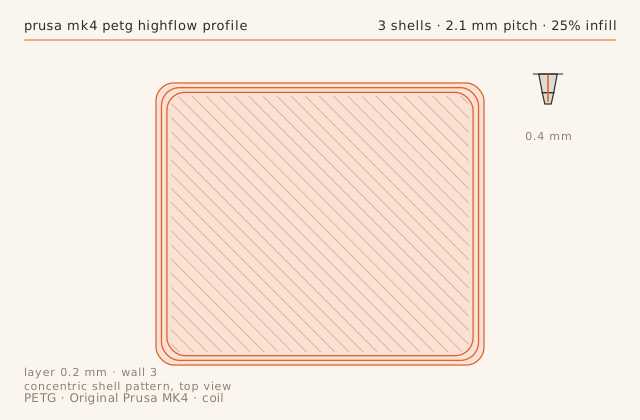
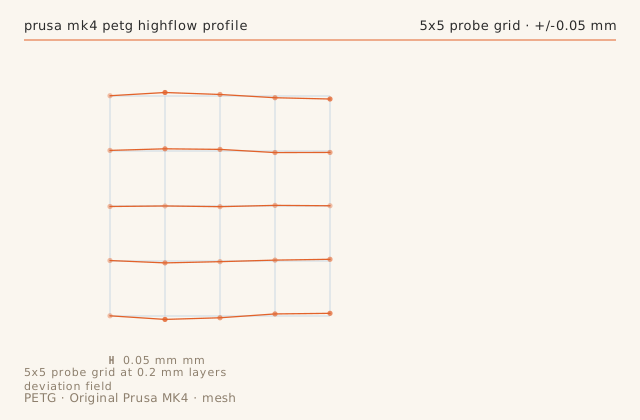
Slice diagramsDrawn from this entry’s own slicer settings.
Print record
- Machine
- Original Prusa MK4
- Material
- PETG
- Nozzle
- 0.4 mm
- Layer height
- 0.2 mm
- Walls
- 3
- Infill
- 25%
- Print time
- 1 h 36 min
- Published
- October 22, 2026
Start by going under, not over
On this machine a 1.00 multiplier produced a 0.45 mm wall against a 0.42 mm target and grew a 50 mm block to 50.21 mm. At 0.96 the wall came in at 0.41 mm and the block at 50.06 mm. PETG's higher melt viscosity means less of the filament is squeezed out sideways, so a nominal multiplier behaves like over-extrusion.
The tell is ridging where perimeters overlap on the top surface. If you see that, reduce the multiplier before you touch the temperature.
Z-hop is not optional on PETG
PETG smears. Without a hop, the nozzle drags across the top of the previous layer on every travel move and leaves a mark. At 0.2 mm the dragging was reduced but not gone; 0.4 mm removed it completely. Going to 0.6 mm introduced stringing from the longer travel and cost time for no benefit.
The z-hop needs a wipe on retraction alongside it. A hop without a wipe just lifts a nozzle that still has a molten tail attached.
Bed temperature decides whether the part holds or fuses
At 75 C the first layer lost adhesion on longer parts. At 90 C the first layer squished out into elephant-footing, and the resulting base was so wide that the part fused to the sheet on the fourth print. 85 C held for ten consecutive prints. A 0.4 mm chamfer on the model's first layer removed what little elephant-footing remained.
Elephant-footing and adhesion are the same variable seen from two sides. Fix it with bed temperature and a chamfer, not with a lower first layer squish.
What can run fast and what cannot
Infill and solid infill run at 140 and 100 mm/s on this machine without a visible penalty. The outer wall cannot go above about 100 mm/s before the melt cannot keep up and the surface goes uneven, and 70 mm/s is the value that produced the best finish on a 96-minute part.
The volumetric ceiling of 11 mm3/s is what binds at 140 mm/s with a 0.4 mm nozzle. Raising it produces under-extrusion in the infill that you will only see when the part fails.
Failure chainWhat went wrong, what was done about it, and what came out the other side.
-
Step 01
Symptom
First layer was glassy but the part released on its own during the fourth print.
Fix
Bed at 90 C caused elephant-footing, and the squished base had actually bonded. Lowered the bed to 85 C and added a 0.4 mm chamfer to the model's first layer.
Result
Adhesion is now consistent across ten prints with no release and no elephant foot.
-
Step 02
Symptom
Ridges along the top surface where perimeters overlapped, and the block measured 50.21 mm.
Fix
Over-extrusion. Reduced the multiplier from 1.00 to 0.96 and switched the top fill pattern to monotonic.
Result
Block measured 50.06 mm and the ridges are gone.
Dimensional check
- Feature
- 50 mm PETG test block
- Nominal
- 50 mm
- Measured
- 50.06 mm+0.06
- Tolerance
- ± 0.08 mm
- Note
- 0.96 multiplier was chosen to keep the block from growing; at 1.00 the same block measured 50.21 mm and the outer walls showed a slight ridge from over-extrusion.
Parameter sweep
| Parameter | Tested | Chosen | Why |
|---|---|---|---|
| Extrusion multiplier | 0.92 / 0.94 / 0.96 / 1.00 | 0.96 | 0.96 produced a 0.41 mm wall; 1.00 produced a 0.45 mm wall with visible ridges where perimeters overlapped. |
| Nozzle temperature | 230 / 235 / 240 / 248 C | 240 C | Below 235 C the layers did not bond on 0.2 mm layers; at 248 C stringing was severe and the surface turned glossy in an uneven way. |
| Z-hop | 0.0 / 0.2 / 0.4 / 0.6 mm | 0.4 mm | PETG loves to smear. 0.2 mm still dragged on some moves; 0.6 mm added visible stringing from the extra travel. |
| Perimeter speed | 50 / 70 / 100 / 130 mm/s | 70 mm/s | Above 100 mm/s the surface went uneven because the melt could not keep up; 70 mm/s gave the best balance for a 96-minute part. |
| Bed temperature | 75 / 80 / 85 / 90 C | 85 C | 75 C lost first-layer adhesion on long parts; 90 C produced elephant-footing that needed a 0.4 mm chamfer to remove. |
Slicer profile
# LayerLog PETG profile v3 — Original Prusa MK4, 0.4 Nextruder nozzle
# PETG bonds to itself; keep the nozzle high and the flow slightly under
nozzle_temp: 240
nozzle_temp_first_layer: 242
bed_temp: 85
bed_temp_first_layer: 85
layer_height: 0.20
first_layer_height: 0.25
perimeters: 3
perimeter_speed: 70
infill_speed: 140
solid_infill_speed: 100
travel_speed: 280
accel: 3500
pressure_advance: 0.042
retraction: 0.8 mm at 30 mm/s, wipe on
max_volumetric_speed: 11 mm3/s
extrusion_multiplier: 0.96
seam_position: rear
z_hop: 0.4 mm on retraction
What carried over
- Run a 0.96 extrusion multiplier for PETG; 1.00 grows a 50 mm block to 50.21 mm.
- Use a 0.4 mm z-hop with a wipe on retraction to stop the nozzle smearing the top surface.
- 85 C bed with a 0.4 mm first-layer chamfer solves elephant-footing and adhesion together.
- Keep the outer wall at 70 mm/s; infill can run at 140 mm/s.
Verdict
This is the working PETG profile for the MK4 at 96 minutes for a typical 50 mm part. The 0.96 multiplier should be re-verified on any new spool.
Also on this machine Original Prusa MK4
-
Print log
Cold pulls on a Nextruder: three pulls, and the pitting that looked like under-extrusion
Surface pitting with correct wall dimensions is not a flow problem, it is contamination. This log covers the cold pull procedure that works on a MK4's Nextruder nozzle, why the temperature matters more than the method, and the purging step after it that most people skip.
- MaterialPLA
- Nozzle0.4 mm
- Layer height0.2 mm
- Print time1 h 1 min
- Failure chain2
-
Print log
MMU3 colour changes: purge volume matters more than anything else in the profile
Multi-colour printing on the MK4 fails in two ways — dirty transitions and dragged strings — and both are purge and ramming problems rather than model or slicer problems. This log covers a 13-change 60 mm plaque, the purge volume that finally produced clean boundaries, and the 9 seconds each ramming cycle costs.
- MaterialPLA
- Nozzle0.4 mm
- Layer height0.2 mm
- Print time3 h 56 min
- Failure chain2
-
Print log
TPU 95A on a direct-drive MK4: 3 hours 25 minutes for a part that takes 50 in PLA
Flexible filament on a direct-drive printer is not hard, it is slow, and the failure mode is always the same — the filament buckles between the gears and the melt zone. This log covers the two settings that prevent it, why flexible parts need deliberate over-extrusion, and how long it really takes.
- MaterialTPU-95A
- Nozzle0.4 mm
- Layer height0.25 mm
- Print time3 h 25 min
- Failure chain2