TPU 95A on a direct-drive MK4: 3 hours 25 minutes for a part that takes 50 in PLA
Flexible filament on a direct-drive printer is not hard, it is slow, and the failure mode is always the same — the filament buckles between the gears and the melt zone. This log covers the two settings that prevent it, why flexible parts need deliberate over-extrusion, and how long it really takes.
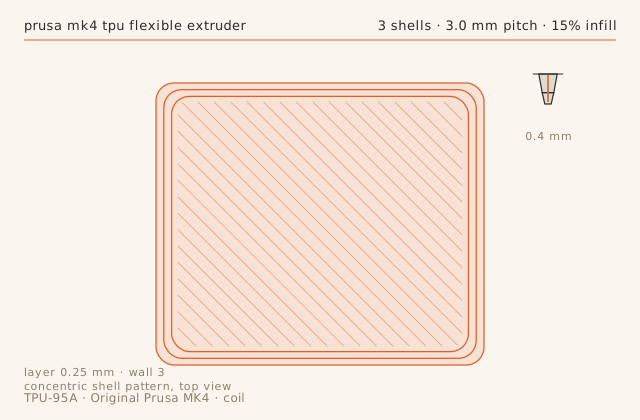
Slice diagramsDrawn from this entry’s own slicer settings.
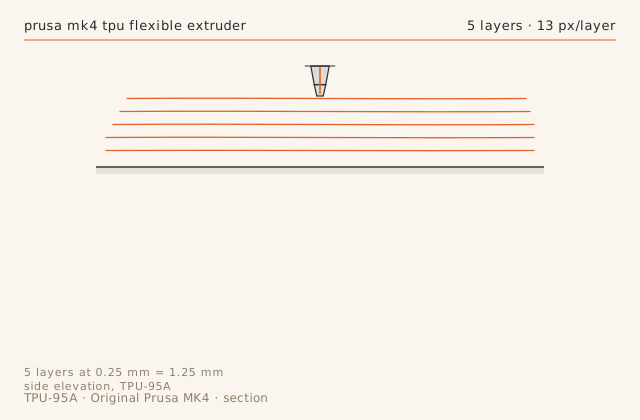
Print record
- Machine
- Original Prusa MK4
- Material
- TPU-95A
- Nozzle
- 0.4 mm
- Layer height
- 0.25 mm
- Walls
- 3
- Infill
- 15%
- Print time
- 3 h 25 min
- Published
- September 26, 2026
Back-pressure is what buckles the filament
The instinct with a flexible filament is to loosen the extruder latch. That helps only if the filament is being crushed; if it is buckling above the gears, the problem is back-pressure, not grip. On this print the buckle happened at 30 minutes with a 6 mm3/s volumetric ceiling. Dropping to 3.5 mm3/s and slowing the outer wall to 20 mm/s let the same spool print through without a single stall.
A quick test that costs nothing: push the filament through by hand at the print temperature. If it takes real force, the volumetric ceiling is too high and no extruder setting will save the print.
Flexible parts need over-extrusion
TPU relaxes after it leaves the nozzle, so a perimeter printed at the same multiplier as PLA comes out thinner and leaves gaps where the perimeter meets the adjacent one. Raising the extrusion multiplier from 1.00 to 1.06 closed the top surface completely. This is one of the few cases where running over 1.00 is the correct answer rather than a symptom of a mis-calibrated extruder.
Part cooling came down from 70 to 40 percent at the same time, because TPU bonds poorly when each layer is quenched before the next arrives.
Speed is a hard constraint, not a preference
A flexible grommet that takes 50 minutes in PLA took 3 hours 25 in TPU 95A on this machine. Most of that is the 20 mm/s outer wall and the 1000 mm/s2 acceleration ceiling. There is no setting that makes this faster without losing the properties that made you choose TPU in the first place.
Plan around it rather than fighting it. Batch every flexible part you need into one session, because the setup is identical and a single stall wastes the whole print.
Where undersize is the goal
The grommet's 12 mm bore came out at 11.42 mm — nearly 0.6 mm under. For a part that grips a cable, that is exactly what you want, and compensating the bore to nominal would produce a grommet that slides instead of holding. Print the first one undersized, test the fit, and add material only if the grip is too tight.
For anything that has to accept a rigid mating part, the opposite applies: add 0.4 mm to the bore and test. Flexible parts do not have a single tolerance direction.
Failure chainWhat went wrong, what was done about it, and what came out the other side.
-
Step 01
Symptom
Filament buckled between the extruder gears and the hotend at about 30 minutes into the print.
Fix
Direct-drive path with very little gap, so the buckling had to be back-pressure: volumetric speed was 6 mm3/s. Dropped to 3.5 mm3/s and reduced the outer wall to 20 mm/s.
Result
Printed through. Total time went from an estimated 1 h 50 to 3 h 25, which is the real cost of flexible filament.
-
Step 02
Symptom
Layer lines visible and gaps between perimeters on the top surface.
Fix
TPU needs to be over-extruded relative to PLA. Raised the extrusion multiplier from 1.00 to 1.06 and dropped part cooling from 70 to 40 percent.
Result
Solid top surface with no gaps. Layer lines are still visible, which is unavoidable at 0.25 mm on a soft material.
Dimensional check
- Feature
- flexible grommet, inner bore
- Nominal
- 12 mm
- Measured
- 11.42 mm-0.58
- Tolerance
- ± 0.2 mm
- Note
- 0.58 mm undersized. Flexible material pulls inward as it cools; for a grommet that has to grip, undersize is a feature, not a defect.
Slicer profile
printer_model: Original Prusa MK4 0.4
layer_height: 0.25
perimeters: 3
infill: 15% gyroid
speed: 25 mm/s outer wall 20
accel: 1000 mm/s2
nozzle_temp: 235
bed_temp: 45
part_cooling: 40%
pressure_advance: 0.060
retraction: 0.2 mm at 15 mm/s, wipe on
max_volumetric_speed: 3.5 mm3/s
spool_holder: direct path, no reverse bowden restriction
What carried over
- Buckle above the gears is back-pressure: lower volumetric speed to 3.5 mm3/s, not the latch tension.
- Run the extrusion multiplier at 1.06 for TPU 95A to close the gaps between perimeters.
- Part cooling at 40 percent; 70 percent quenches each layer before the next bonds.
- A 50-minute PLA part takes 3 h 25 in TPU at 20 mm/s outer wall; batch flexible jobs together.
Verdict
TPU 95A is now repeatable on this machine at 3.5 mm3/s with a dedicated profile. It stays a batch material rather than an everyday one.
Also on this machine Original Prusa MK4
-
Print log
Cold pulls on a Nextruder: three pulls, and the pitting that looked like under-extrusion
Surface pitting with correct wall dimensions is not a flow problem, it is contamination. This log covers the cold pull procedure that works on a MK4's Nextruder nozzle, why the temperature matters more than the method, and the purging step after it that most people skip.
- MaterialPLA
- Nozzle0.4 mm
- Layer height0.2 mm
- Print time1 h 1 min
- Failure chain2
-
Print log
MMU3 colour changes: purge volume matters more than anything else in the profile
Multi-colour printing on the MK4 fails in two ways — dirty transitions and dragged strings — and both are purge and ramming problems rather than model or slicer problems. This log covers a 13-change 60 mm plaque, the purge volume that finally produced clean boundaries, and the 9 seconds each ramming cycle costs.
- MaterialPLA
- Nozzle0.4 mm
- Layer height0.2 mm
- Print time3 h 56 min
- Failure chain2
-
Print log
Organic supports on the MK4: the z-gap that works for PETG is not the one that works for PLA
Tree supports look like a solved problem until the material changes. PETG welds to itself across a 0.15 mm gap, so the standard PLA clearance fuses the support to the part. This log covers the gap and interface settings that make PETG supports break away by hand, and the stability fix that stopped a tall tree from falling over.
- MaterialPETG
- Nozzle0.4 mm
- Layer height0.2 mm
- Print time2 h 52 min
- Failure chain2