MK4 ringing tower: input shaper did most of the work, pressure advance did the rest
The MK4 ships with input shaper enabled, so the useful question is not whether to turn it on but when to recalibrate. This log covers a stock 60 mm tower, the two independent surface problems on it, and the measured difference between a shaper tuned on one bench and the same machine on another.
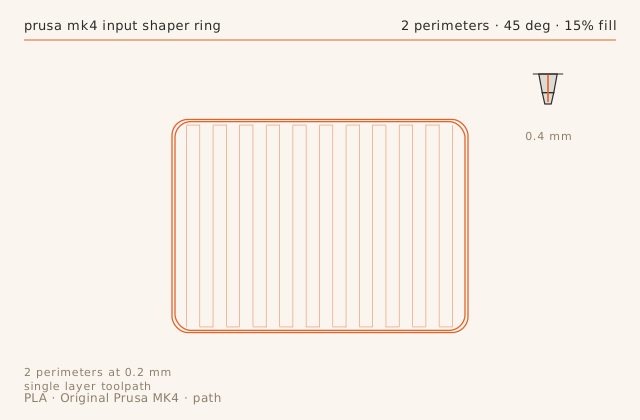
Slice diagramsDrawn from this entry’s own slicer settings.
Print record
- Machine
- Original Prusa MK4
- Material
- PLA
- Nozzle
- 0.4 mm
- Layer height
- 0.2 mm
- Walls
- 2
- Infill
- 15%
- Print time
- 47 min
- Published
- August 28, 2026
Recalibrate after moving the machine, not after every print
Input shaper compensates for the machine's own resonance, and the resonance depends on what the machine is standing on. Moving this MK4 from a heavy bench to a lighter one changed the ringing enough to be visible, from 0.19 mm of corner deviation down to 0.06 mm after recalibration at the same speed and acceleration.
The built-in calibration on the LCD takes about 12 minutes and needs no tools. Run it when the machine moves, when the table changes, and after any change to the toolhead. Not after every spool.
Separate the symptoms before you treat them
This tower had two visible defects: ringing behind the corners, and small blobs at the seam. They look like one problem and they are two. Ringing is a resonance issue governed by input shaper and acceleration; a seam blob is a melt-flow issue governed by pressure advance and retraction.
Fixing pressure advance from 0.048 to 0.035 removed the blobs and changed nothing about the ringing, which is the confirmation that the diagnosis was right. If a change fixes two symptoms at once, be suspicious — it usually means you have not understood either.
What acceleration to actually run
With input shaper active, this machine holds clean corners at 4000 mm/s2 and 150 mm/s. Pushing to 6000 mm/s2 gained about 9 minutes on a 47-minute print and reintroduced visible ringing at 0.11 mm. That trade is only worth making on a large functional part where surface does not matter.
The more useful lever on this machine turned out to be outer wall speed, not acceleration. Dropping the outer wall from 150 to 90 mm/s while leaving acceleration alone produced a visibly better surface for about four extra minutes.
What the tower is for
A 60 mm tower with two perimeters and no infill takes 47 minutes and shows resonance, pressure advance, seam placement and Z banding all at once. Print one after any firmware update, any belt change and any toolhead work, and photograph it against the same background each time.
The photograph matters more than the print. Six towers on a shelf tell you nothing; six photographs with dates tell you when the machine started to change.
Failure chainWhat went wrong, what was done about it, and what came out the other side.
-
Step 01
Symptom
Visible ringing behind corners on a plain 60 mm tower at 150 mm/s, about 4 mm of ripples decaying outward.
Fix
Confirmed input shaper was active and set to the firmware's stock profile, then re-ran the built-in shaper calibration from the LCD because the machine had been moved to a different bench.
Result
Corner deviation measured 0.06 mm against 0.19 mm before recalibration. Ripples no longer visible at arm's length.
-
Step 02
Symptom
Small blobs at the seam on the same tower, unrelated to ringing but appearing at the same time.
Fix
The MK4's pressure advance value had been tuned on a different filament. Ran a PA tower: 0.035 for this PLA against 0.048 previously set.
Result
Seam blobs gone. Corner detail unchanged, confirming the two symptoms were independent.
Dimensional check
- Feature
- ringing tower, corner deviation at 60 mm height
- Nominal
- 0 mm
- Measured
- 0.06 mm+0.06
- Tolerance
- ± 0.03 mm
- Note
- Input shaper is on by default on the MK4 and reduced ringing from 0.19 mm to 0.06 mm at the same speed. The remaining 0.06 mm is not worth chasing.
Slicer profile
printer_model: Original Prusa MK4 0.4
layer_height: 0.20
perimeters: 2
infill: 15% grid
speed: 150 mm/s outer wall 90
accel: 4000 mm/s2 (input shaper default)
nozzle_temp: 215
bed_temp: 60
part_cooling: 100%
pressure_advance: 0.035
extrusion_multiplier: 0.98
What carried over
- Recalibrate input shaper after moving the machine to a different bench or table.
- Ringing and seam blobs are separate faults with separate causes; fix them separately.
- 4000 mm/s2 holds clean corners here; 6000 mm/s2 saved 9 minutes and brought ringing back.
- Lowering outer wall speed improved the surface more than raising acceleration did.
Verdict
The MK4 is running stock input shaper with a corrected pressure advance of 0.035 for this PLA. No further tuning planned until the toolhead changes.
Also on this machine Original Prusa MK4
-
Print log
Cold pulls on a Nextruder: three pulls, and the pitting that looked like under-extrusion
Surface pitting with correct wall dimensions is not a flow problem, it is contamination. This log covers the cold pull procedure that works on a MK4's Nextruder nozzle, why the temperature matters more than the method, and the purging step after it that most people skip.
- MaterialPLA
- Nozzle0.4 mm
- Layer height0.2 mm
- Print time1 h 1 min
- Failure chain2
-
Print log
MMU3 colour changes: purge volume matters more than anything else in the profile
Multi-colour printing on the MK4 fails in two ways — dirty transitions and dragged strings — and both are purge and ramming problems rather than model or slicer problems. This log covers a 13-change 60 mm plaque, the purge volume that finally produced clean boundaries, and the 9 seconds each ramming cycle costs.
- MaterialPLA
- Nozzle0.4 mm
- Layer height0.2 mm
- Print time3 h 56 min
- Failure chain2
-
Print log
TPU 95A on a direct-drive MK4: 3 hours 25 minutes for a part that takes 50 in PLA
Flexible filament on a direct-drive printer is not hard, it is slow, and the failure mode is always the same — the filament buckles between the gears and the melt zone. This log covers the two settings that prevent it, why flexible parts need deliberate over-extrusion, and how long it really takes.
- MaterialTPU-95A
- Nozzle0.4 mm
- Layer height0.25 mm
- Print time3 h 25 min
- Failure chain2