Stringing on the KE: temperature first, retraction second, and the trade you make to get it
Stringing is the most over-diagnosed problem in FDM printing, and the diagnosis is almost always the same order: temperature, then travel, then retraction. This log takes a tower from heavy unbroken threads to fine wisps on the KE, and explains the surface cost of getting there.
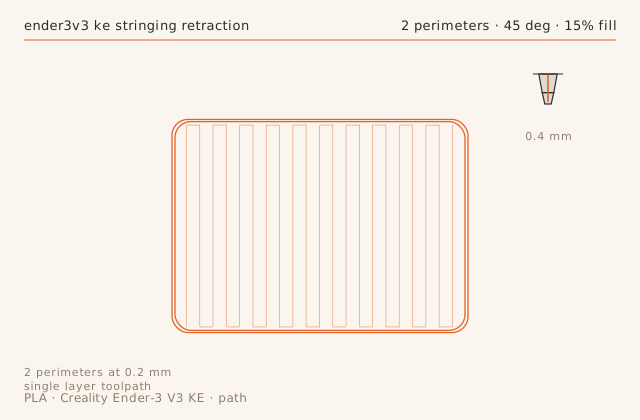
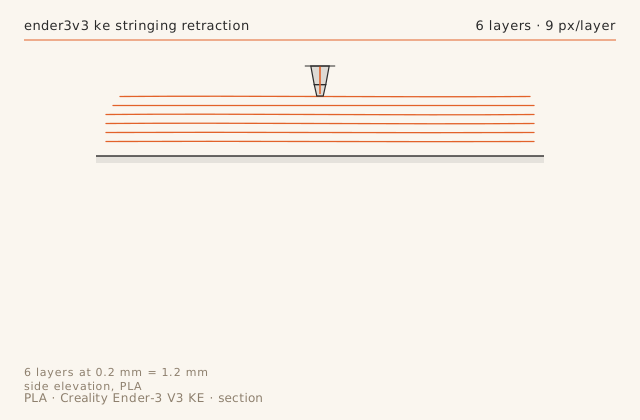
Slice diagramsDrawn from this entry’s own slicer settings.
Print record
- Machine
- Creality Ender-3 V3 KE
- Material
- PLA
- Nozzle
- 0.4 mm
- Layer height
- 0.2 mm
- Walls
- 2
- Infill
- 15%
- Print time
- 1 h 16 min
- Published
- September 12, 2026
Work the order, do not skip to retraction
Retraction is the visible fix and the least effective one. Raising retraction first is how people end up at 2 mm of retraction with a partially clogged nozzle and strings still present. The order that works is: lower the nozzle temperature in 5 C steps until strings shorten, then check the travel speed and the wipe, and only then adjust retraction.
On this KE the temperature move from 220 to 208 C took the tower from long unbroken threads to short wisps. Retraction then went from 0.8 to 1.2 mm and removed most of what was left.
A wet spool looks like a temperature problem
PLA that has absorbed moisture produces steam in the melt zone, and the escaping steam pushes a small amount of molten plastic out of the nozzle between moves. The result is stringing that no retraction setting will fix, and it usually arrives on the second half of a spool. If a spool that printed cleanly last week is suddenly stringy at the same settings, dry it before changing anything.
This spool had been open for three weeks in a humid workshop. The temperature fix worked, but the underlying cause was moisture, and the next spool from the same box will need the same handling.
The surface cost of running cooler
At 208 C the inner walls at 120 mm/s came out matt and the corners lost gloss. The fix was to slow the infill to 100 mm/s rather than raise the temperature, because raising it would have brought the strings back. Slowing the infill cost about nine minutes on a 76-minute part.
This is the general shape of the trade: stringing is controlled by temperature, surface finish by temperature and speed together, and when you lower the temperature you have to lower the speed to compensate if you care about gloss.
Accept the wisps
Fine short wisps between two close features are normal for PLA on any direct-drive printer and are not worth further tuning. They come off with a fingernail or a few seconds with a heat gun. If you are chasing a completely string-free print, you will end up at a temperature where the layer bonds are too weak to be useful.
Write down the temperature you settled on and the spool it was for. The next spool from the same manufacturer will likely want a different number.
Failure chainWhat went wrong, what was done about it, and what came out the other side.
-
Step 01
Symptom
Heavy stringing across every 40 mm gap, with long unbroken threads rather than fine wisps.
Fix
Nozzle temperature was 220 C from a previous spool. Dropped to 208 C in two steps and raised retraction from 0.8 to 1.2 mm.
Result
Long threads gone. Fine wisps remain at the top of the tower, which is normal for PLA.
-
Step 02
Symptom
After the temperature change, the surface lost gloss and the corners looked slightly matte.
Fix
208 C was too cold for the inner walls at 120 mm/s. Reduced the infill speed to 100 mm/s rather than raising the temperature back up.
Result
Gloss restored with strings still suppressed. Better trade than going back to 215 C.
Dimensional check
- Feature
- stringing tower bridge gap
- Nominal
- 40 mm
- Measured
- 39.96 mm-0.04
- Tolerance
- ± 0.08 mm
- Note
- Dimension was never the issue on this test; the measurement is included so the stringing result can be compared against a part that is otherwise in tolerance.
Slicer profile
printer_model: Creality Ender-3 V3 KE 0.4
layer_height: 0.20
perimeters: 2
infill: 15% grid
perimeter_speed: 60
infill_speed: 120
accel: 3000
nozzle_temp: 208
bed_temp: 60
part_cooling: 100%
pressure_advance: 0.042
retraction: 1.2 mm at 35 mm/s, wipe 0.6 mm
max_volumetric_speed: 12 mm3/s
travel_speed: 300 mm/s
What carried over
- Lower the nozzle temperature before touching retraction; 220 to 208 C removed the threads here.
- A spool that suddenly strings at unchanged settings has absorbed moisture.
- Slowing infill from 120 to 100 mm/s restored gloss at 208 C without bringing the strings back.
- Short wisps are normal for PLA and come off with a fingernail; do not tune them away.
Verdict
Stringing is under control at 208 C and 1.2 mm retraction on this spool, at a cost of 9 minutes on a 76-minute print.
Also on this machine Creality Ender-3 V3 KE
-
Print log
Z banding on the KE: an 8 mm period, then a 2 mm period, and two different fixes
Z banding has a period, and the period tells you the cause before you touch anything. This log works through two bands on the same machine — one at the leadscrew rotation period and one at the thread pitch — and shows why the first needed a mechanical fix and the second needed a software one.
- MaterialPLA
- Nozzle0.4 mm
- Layer height0.2 mm
- Print time58 min
- Failure chain2
-
Tune profile
TPU 95A on the KE's stock extruder: 3 hours 44 minutes and one very specific buckling point
The KE's Sprite extruder is direct drive, which makes flexible filament possible rather than easy. This profile is built around a 3.0 mm3/s ceiling that the machine will actually sustain, and it documents the one place where every failed attempt fails.
- MaterialTPU-95A
- Nozzle0.4 mm
- Layer height0.24 mm
- Print time3 h 44 min
- Failure chain2
-
Print log
Shimming the KE's bed: 0.15 mm of mesh error that compensation could not hide
Auto-levelling has a limit, and on a 0.28 mm first layer that limit is about 0.08 mm. This log covers a KE with a 0.15 mm low corner, the shim washers that fixed it mechanically, and the nine-position first-layer test that proves it worked.
- MaterialPLA
- Nozzle0.4 mm
- Layer height0.28 mm
- Print time41 min
- Failure chain2