Organic supports on the MK4: the z-gap that works for PETG is not the one that works for PLA
Tree supports look like a solved problem until the material changes. PETG welds to itself across a 0.15 mm gap, so the standard PLA clearance fuses the support to the part. This log covers the gap and interface settings that make PETG supports break away by hand, and the stability fix that stopped a tall tree from falling over.
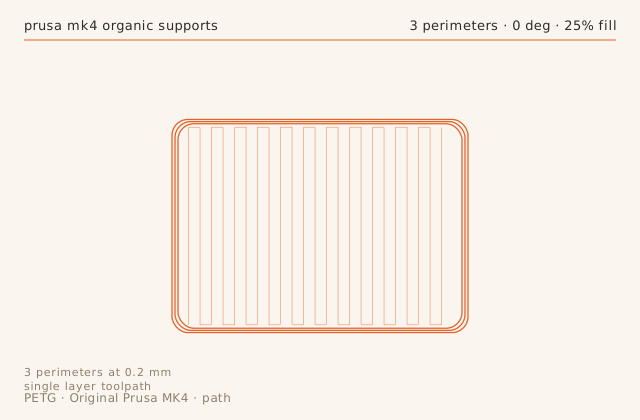
Slice diagramsDrawn from this entry’s own slicer settings.
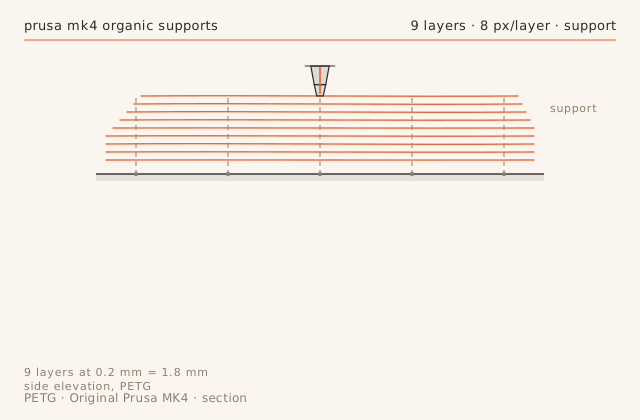
Print record
- Machine
- Original Prusa MK4
- Material
- PETG
- Nozzle
- 0.4 mm
- Layer height
- 0.2 mm
- Walls
- 3
- Infill
- 25%
- Print time
- 2 h 52 min
- Published
- September 15, 2026
The z-gap is material-specific
A 0.15 mm gap is fine for PLA and too small for PETG. The reason is that PETG bonds to itself more aggressively, so at 0.15 mm the interface layer and the model surface are still within bonding range. Raising the gap to 0.20 mm fixed the fusing; the surface left behind is a little rougher, and it is a surface no knife has touched, which is the trade to make.
This is the second-most-common support mistake after not using an interface at all. If you print the same model in two materials, keep two support presets rather than one.
Give the interface its own thickness
One interface layer is not enough at 0.2 mm layer height: the interface is a single partial layer that varies in thickness across the supported area, and parts of it bond while other parts do not. Three interface layers produced a rigid plate that breaks away as a unit and leaves a consistent surface.
The interface also prints slower in most slicers, which is correct. The supported surface is where the model's appearance is decided, so it deserves the time.
Tall trees need a wider base
The support detached at 60 percent height because the tree had a narrow base under a tall, light structure. The fix is two settings that cost almost nothing: a brim on the support only, and a branch angle reduced from 50 to 45 degrees. The narrower angle makes the tree wider at the bottom and more resistant to the small sideways push the nozzle gives it on every travel.
Do not fix this with more support material density. Density adds mass at the top of the tree as well as the bottom and makes the problem worse.
Count the removal time, not just the result
The 0.15 mm gap produced a better-supported surface — 0.06 mm of sag against 0.12 mm — but removal went from about 20 seconds by hand to several minutes with a knife and left visible marks. For a functional bracket, the hand-removable version wins even with the rougher underside.
Write down both numbers. A support setting that takes four extra minutes to remove across a batch of twenty parts costs more than the print time it saves.
Failure chainWhat went wrong, what was done about it, and what came out the other side.
-
Step 01
Symptom
Support fused to the model on the flat underside, requiring a knife and leaving white stress marks.
Fix
Z-gap was 0.15 mm with PETG, which bonds to itself too well at that distance. Raised to 0.20 mm and increased support interface layers from 1 to 3 so the interface had its own structure to break away from.
Result
Supports snap off by hand. Surface underneath is slightly rougher but has no knife marks.
-
Step 02
Symptom
The whole support tree detached and fell over mid-print at 60 percent height.
Fix
Organic supports had a narrow base on a tall, light part. Added a 6 mm brim to the support only, and lowered the support branch angle from 50 to 45 degrees.
Result
Second attempt completed. Support tree was stable despite a 4 mm mid-print wobble.
Dimensional check
- Feature
- overhang surface flatness under supported region
- Nominal
- 0 mm
- Measured
- 0.12 mm+0.12
- Tolerance
- ± 0.08 mm
- Note
- 0.12 mm of sag on the supported overhang with a 0.20 mm z-gap. Reducing the gap to 0.15 mm improved it to 0.06 mm but doubled the removal time.
Slicer profile
printer_model: Original Prusa MK4 0.4
layer_height: 0.20
perimeters: 3
infill: 25% grid
support: organic, 0.20 mm z-gap
support_angle: 55 deg
support_interface: 3 layers
speed: 120 mm/s outer wall 60
accel: 4000 mm/s2
nozzle_temp: 240
bed_temp: 85
part_cooling: 50%
pressure_advance: 0.042
What carried over
- Use 0.20 mm z-gap for PETG supports; 0.15 mm fuses the interface to the part.
- Three interface layers break away as a unit; one layer does not.
- Add a support-only brim and reduce branch angle to 45 degrees for tall trees.
- A 0.15 mm gap gave 0.06 mm sag but turned a 20-second removal into several minutes.
Verdict
PETG support preset settled at a 0.20 mm gap with a 3-layer interface. The rough underside is acceptable for functional parts and unacceptable for cosmetic ones.
Also on this machine Original Prusa MK4
-
Print log
Cold pulls on a Nextruder: three pulls, and the pitting that looked like under-extrusion
Surface pitting with correct wall dimensions is not a flow problem, it is contamination. This log covers the cold pull procedure that works on a MK4's Nextruder nozzle, why the temperature matters more than the method, and the purging step after it that most people skip.
- MaterialPLA
- Nozzle0.4 mm
- Layer height0.2 mm
- Print time1 h 1 min
- Failure chain2
-
Print log
MMU3 colour changes: purge volume matters more than anything else in the profile
Multi-colour printing on the MK4 fails in two ways — dirty transitions and dragged strings — and both are purge and ramming problems rather than model or slicer problems. This log covers a 13-change 60 mm plaque, the purge volume that finally produced clean boundaries, and the 9 seconds each ramming cycle costs.
- MaterialPLA
- Nozzle0.4 mm
- Layer height0.2 mm
- Print time3 h 56 min
- Failure chain2
-
Print log
TPU 95A on a direct-drive MK4: 3 hours 25 minutes for a part that takes 50 in PLA
Flexible filament on a direct-drive printer is not hard, it is slow, and the failure mode is always the same — the filament buckles between the gears and the melt zone. This log covers the two settings that prevent it, why flexible parts need deliberate over-extrusion, and how long it really takes.
- MaterialTPU-95A
- Nozzle0.4 mm
- Layer height0.25 mm
- Print time3 h 25 min
- Failure chain2