A PLA profile for the MK4 that is tuned on measurements, not on appearance
The MK4 prints PLA well out of the box, which makes it easy to skip calibration entirely and then wonder why one spool behaves differently from the next. This profile is built from five measured test matrices, including the extrusion multiplier that most people never check because the default is close enough.
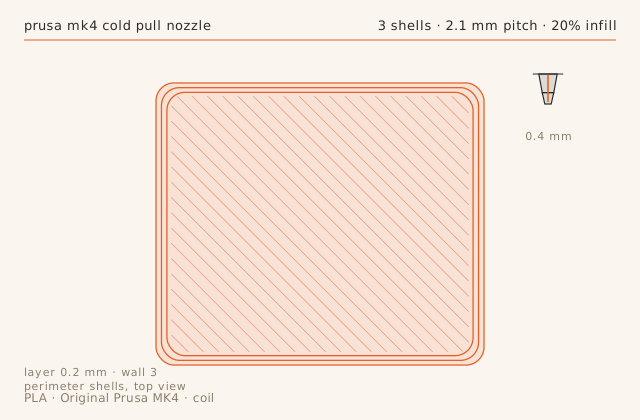
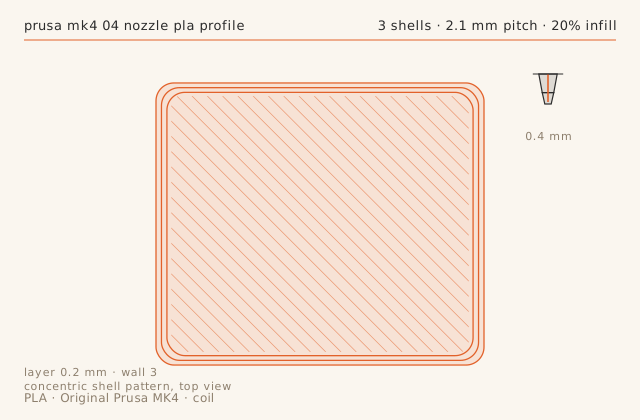
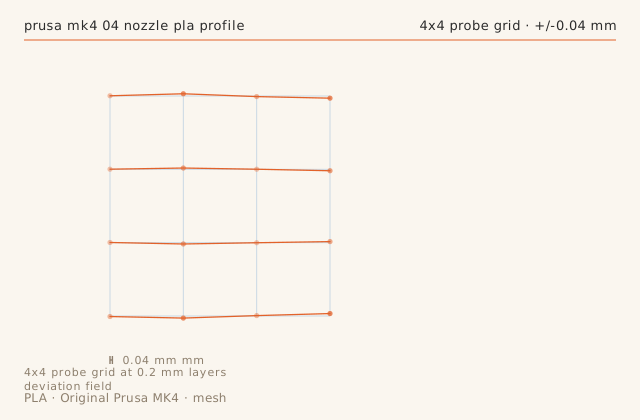
Slice diagramsDrawn from this entry’s own slicer settings.
Print record
- Machine
- Original Prusa MK4
- Material
- PLA
- Nozzle
- 0.4 mm
- Layer height
- 0.2 mm
- Walls
- 3
- Infill
- 20%
- Print time
- 1 h 24 min
- Published
- September 6, 2026
The multiplier is a measurement, not an opinion
Print a single-wall 40 mm cube at each candidate multiplier and measure the wall with a caliper in four places, discarding the seam. On this machine 0.96, 0.98, 1.00 and 1.02 produced walls of 0.39, 0.41, 0.43 and 0.44 mm against a 0.42 mm target. The default of 1.00 is 0.01 mm over, which is invisible on a 20 mm part and 0.09 mm over on a 40 mm cube.
Multiplier is also the number most affected by a spool of filament that is slightly out of tolerance. Re-measure when you change brand, not when you change colour.
Temperature trades strength against strings, and strings are tunable
At 205 C this PLA produced visibly weaker bonds on a 3 mm wall; at 220 C it produced fine strings across 40 mm gaps. 215 C is the point where the wall is strong and the strings are short wisps. The strings at 220 C were partly a filament-diameter problem, so if your spool sits at 1.76 mm, expect to run cooler than you would otherwise.
A 0.5 mm wipe on retraction removed most of what was left. Note the direction: fixing strings with a wipe rather than with more retraction keeps the nozzle from dragging molten material back into the cold zone.
Outer wall speed is the surface control
Inner walls and infill can run at 180 mm/s on this machine without any visible penalty. The outer wall cannot: at 120 mm/s it loses gloss and at 150 mm/s the surface becomes slightly rough under raking light. 90 mm/s costs roughly four minutes on a part that takes an hour and a half and is the difference between a part that looks printed and a part that looks manufactured.
Top fill pattern matters for the same reason and costs nothing. Switching from rectilinear to monotonic removed the small ridges where top infill crossed the perimeter.
Re-derive the profile, do not copy it
Every number here is specific to the current nozzle. Nextruder nozzles wear, and a nozzle that has printed 500 grams of filled material behaves like a slightly larger orifice. Re-run the wall measurement after any nozzle change and adjust the multiplier rather than the temperature.
The one value that is not worth re-deriving is the perimeter speed. It is a surface-quality preference, and if you like the look of 120 mm/s on your parts, keep it.
Failure chainWhat went wrong, what was done about it, and what came out the other side.
-
Step 01
Symptom
Fine strings between separated features on a part with 40 mm gaps.
Fix
Filament was at the top of its diameter tolerance. Reduced nozzle temperature from 220 to 215 C and confirmed retraction at 0.8 mm; also enabled a 0.5 mm wipe on retraction.
Result
Strings reduced to short wisps removable with a fingernail. Not eliminated, which is normal for PLA on a direct drive.
Dimensional check
- Feature
- 40 mm flow test cube
- Nominal
- 40 mm
- Measured
- 40.03 mm+0.03
- Tolerance
- ± 0.05 mm
- Note
- 0.98 extrusion multiplier was chosen over 1.00 because it produced a 0.41 mm measured wall against a 0.42 mm target; at 1.00 the wall was 0.43 mm and the cube 40.09 mm.
Parameter sweep
| Parameter | Tested | Chosen | Why |
|---|---|---|---|
| Extrusion multiplier | 0.96 / 0.98 / 1.00 / 1.02 | 0.98 | Wall measured 0.39 / 0.41 / 0.43 / 0.44 mm. 0.98 is the closest to the 0.42 mm target and keeps the cube inside 40.05 mm. |
| Nozzle temperature | 205 / 210 / 215 / 220 C | 215 C | At 205 C layer bonding was visibly weaker on a 3 mm wall; 220 C produced fine strings across 40 mm gaps even with retraction tuned. |
| Pressure advance | 0.028 / 0.035 / 0.042 / 0.050 | 0.035 | Sharpest corners without gaps at the seam on a 20 mm hollow cube. |
| Perimeter speed | 60 / 90 / 120 / 150 mm/s | 90 mm/s | At 120 mm/s the outer wall lost gloss; 90 mm/s cost about four minutes on a typical part and looked noticeably better. |
| Top fill pattern | rectilinear / monotonic / concentric | monotonic | Removed the small ridges where top infill crossed the perimeter, at no time cost. |
Slicer profile
# LayerLog PLA profile v4 — Original Prusa MK4, 0.4 Nextruder nozzle
# Run the input shaper calibration after any toolhead or bench change
nozzle_temp: 215
nozzle_temp_first_layer: 215
bed_temp: 60
bed_temp_first_layer: 60
chamber: open, no enclosure
layer_height: 0.20
first_layer_height: 0.25
perimeters: 3
perimeter_speed: 90
infill_speed: 180
solid_infill_speed: 140
travel_speed: 300
accel: 4000
pressure_advance: 0.035
retraction: 0.8 mm at 35 mm/s
max_volumetric_speed: 15 mm3/s
extrusion_multiplier: 0.98
seam_position: rear
top_fill_pattern: monotonic
What carried over
- Measure the single-wall cube at four multipliers; 0.98 gave 0.41 mm against a 0.42 mm target here.
- 215 C holds wall strength without the fine strings seen at 220 C.
- Keep the outer wall at 90 mm/s; inner walls and infill can run at 180 mm/s.
- Monotonic top fill removes the ridges at the top perimeter at no time cost.
Verdict
This is the working PLA profile for the MK4's current nozzle. Re-measure the wall after every nozzle change rather than trusting the multiplier.
Also on this machine Original Prusa MK4
-
Print log
Cold pulls on a Nextruder: three pulls, and the pitting that looked like under-extrusion
Surface pitting with correct wall dimensions is not a flow problem, it is contamination. This log covers the cold pull procedure that works on a MK4's Nextruder nozzle, why the temperature matters more than the method, and the purging step after it that most people skip.
- MaterialPLA
- Nozzle0.4 mm
- Layer height0.2 mm
- Print time1 h 1 min
- Failure chain2
-
Print log
MMU3 colour changes: purge volume matters more than anything else in the profile
Multi-colour printing on the MK4 fails in two ways — dirty transitions and dragged strings — and both are purge and ramming problems rather than model or slicer problems. This log covers a 13-change 60 mm plaque, the purge volume that finally produced clean boundaries, and the 9 seconds each ramming cycle costs.
- MaterialPLA
- Nozzle0.4 mm
- Layer height0.2 mm
- Print time3 h 56 min
- Failure chain2
-
Print log
TPU 95A on a direct-drive MK4: 3 hours 25 minutes for a part that takes 50 in PLA
Flexible filament on a direct-drive printer is not hard, it is slow, and the failure mode is always the same — the filament buckles between the gears and the melt zone. This log covers the two settings that prevent it, why flexible parts need deliberate over-extrusion, and how long it really takes.
- MaterialTPU-95A
- Nozzle0.4 mm
- Layer height0.25 mm
- Print time3 h 25 min
- Failure chain2