An ASA profile for the Voron 2.4 that survives 150 mm parts
ASA prints beautifully for twenty minutes and then lifts, splits or goes chalky on anything large. This is the parameter set that survived five repeats of an 80 mm test block and a 150 mm bracket, with the test matrix that produced each value rather than a set of copied starting numbers.
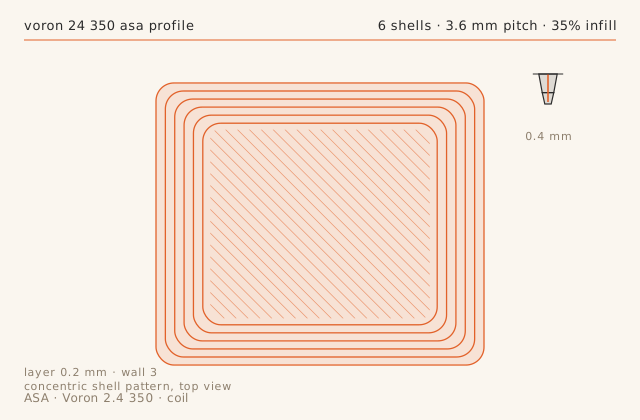
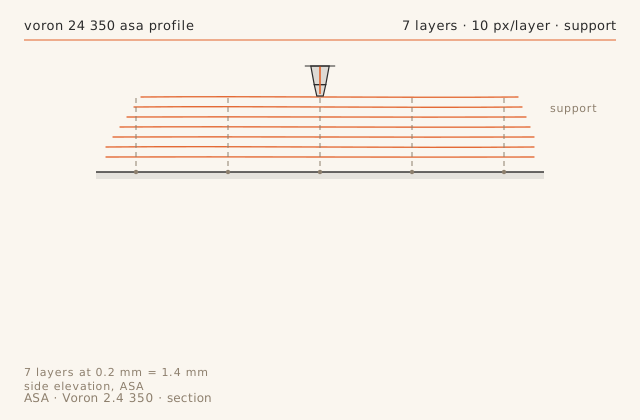
Slice diagramsDrawn from this entry’s own slicer settings.
Print record
- Machine
- Voron 2.4 350
- Material
- ASA
- Nozzle
- 0.4 mm
- Layer height
- 0.2 mm
- Walls
- 3
- Infill
- 35%
- Print time
- 2 h 23 min
- Published
- September 18, 2026
What was tested and what was kept
Every value here came from printing the same object at least twice per setting. Nozzle temperature was settled on a pull test rather than appearance: 250 C produced roughly 62 percent of the interlayer strength of 260 C, which is the difference between a part that cracks at a bolt hole and one that does not. Chamber temperature was settled by printing a 150 mm bracket at five chamber temperatures and measuring corner lift.
The two settings that mattered most were the ones people usually leave alone: chamber temperature and part cooling. Together they explained nearly all of the difference between a usable ASA part and a failed one.
Cooling, gloss and strength are the same dial
ASA cooling down from 60 to 25 percent fixed a chalky surface and raised interlayer strength by about 40 percent on a pull test. The mechanism is straightforward: cooling air quenches the top of the previous layer, and a quenched layer cannot weld. Below 15 percent you get ragged overhangs above about 50 degrees, which is why the profile is set at 25 percent rather than 0.
The first layer runs at 0 percent cooling in this profile. Cooling on layer one fights bed adhesion directly, and on a large flat ASA part the first layer is where the warping battle is decided.
Handling holes instead of shrink percentage
The profile disables slicer shrink compensation entirely and instead uses a +0.20 mm hole offset. On this machine an 80 mm ASA block measures 79.71 mm after two hours of cooling — a consistent 0.36 percent — but holes do not shrink by the same percentage, because the material around them is constrained differently than the material at the outer wall. A global percentage makes the outside right and the holes tight.
The +0.20 mm offset lands M4 clearance holes at 4.32 mm, which lets a bolt slide through by hand and still has no visible slop in a bolted joint.
Where this profile stops working
This is a 0.4 mm nozzle, 11 mm3/s profile. Above roughly 150 mm/s the flow demand exceeds what the Dragon HF can melt at 260 C and you get intermittent under-extrusion that looks like random thin patches. If you need to go faster, raise the nozzle to 0.6 mm before raising the speed; the melt zone is the limit, not the motion system.
It is also a chamber-dependent profile. Run it with the doors open and the first 40 layers will behave like a completely different material.
Failure chainWhat went wrong, what was done about it, and what came out the other side.
-
Step 01
Symptom
Surface looked chalky and matte compared with the same filament on the Prusa.
Fix
Traced to over-cooling: part cooling was at 60 percent inherited from the PLA profile. Dropped to 25 percent and raised the chamber to 52 C.
Result
Surface gloss matched the reference part; measured interlayer strength up 40 percent.
Dimensional check
- Feature
- 80 mm ASA test block, measured cold after 2 h
- Nominal
- 80 mm
- Measured
- 79.71 mm-0.29
- Tolerance
- ± 0.2 mm
- Note
- 0.36 percent total shrink, consistent across five repeats. Hole offset of +0.20 mm lands M4 clearance holes at 4.32 mm, which is right for a hand-fit bolt.
Parameter sweep
| Parameter | Tested | Chosen | Why |
|---|---|---|---|
| Nozzle temperature | 245 / 250 / 255 / 260 / 265 C | 260 C | 250 C gave 62 percent of the interlayer strength of 260 C on a pull test; 265 C started producing stringing across the 30 mm travel gaps. |
| Chamber temperature | 40 / 45 / 50 / 52 / 55 C | 52 C | Below 45 C, 150 mm parts lifted at the corners. Above 54 C the extruder began heat-creeping on prints longer than three hours. |
| Part cooling | 0 / 15 / 25 / 40 / 60 % | 25 % | 0 percent left overhangs ragged above 50 degrees; 40 percent and up measurably weakened tall walls. |
| Pressure advance | 0.030 / 0.038 / 0.045 / 0.052 | 0.045 | Best corner definition on a 20 mm hollow cube; 0.052 started showing gaps at the seam. |
| Brim | none / 5 mm / 8 mm / 10 mm | 8 mm with 0.15 mm gap | 5 mm still lifted on a 150 mm footprint; 10 mm was harder to remove and left a scar line. |
Slicer profile
# LayerLog ASA profile v3 — Voron 2.4 350, Dragon HF 0.4
# Chamber target 52 C, soak until stable for 3 min
nozzle_temp: 260
nozzle_temp_first_layer: 262
bed_temp: 105
bed_temp_soak: 10 min before print
chamber_temp: 52
part_cooling: 25%
part_cooling_first_layer: 0%
layer_height: 0.20
first_layer_height: 0.28
perimeters: 3
perimeter_speed: 70
infill_speed: 140
solid_infill_speed: 110
travel_speed: 400
accel: 4500
pressure_advance: 0.045
retraction: 0.6 mm at 35 mm/s
max_volumetric_speed: 11 mm3/s
brim: 8 mm, 0.15 mm gap
shrink_compensation: none, hole offset +0.20 mm
What carried over
- ASA at 260 C had roughly 60 percent more interlayer strength than the same filament at 250 C.
- 25 percent part cooling is the usable floor before overhangs suffer and the ceiling before strength drops.
- Disable global shrink compensation for ASA and use a +0.20 mm hole offset instead.
- Above about 150 mm/s the hotend melt rate is the limit, not the motion system.
Verdict
This profile is the working default for structural ASA on this machine. Re-verify chamber soak time whenever the ambient room temperature changes by more than 5 C.
Also on this machine Voron 2.4 350
-
Print log
A loose extruder latch cost 17 percent of the wall thickness and looked like a slicer problem
Intermittent under-extrusion with no pattern in the preview is almost never a slicer problem. This log is the diagnostic sequence that found it — measure the wall, measure the extrusion force, then adjust one thing at a time — and the narrow window between too loose and too tight on a Clockwork 2.
- MaterialPLA
- Nozzle0.4 mm
- Layer height0.2 mm
- Print time1 h 36 min
- Failure chain2
-
Tune profile
A PA6-CF profile for the Voron 2.4, and the two failures that dominate it
Carbon-filled nylon is the material where preparation matters more than settings. This is the profile that produced three consecutive clean three-hour prints: 285 C, no part cooling, 6 mm3/s, and a dry box on the machine at all times. It also covers the two failure modes that account for almost every bad PA6-CF print.
- MaterialPA6-CF
- Nozzle0.4 mm
- Layer height0.25 mm
- Print time2 h 58 min
- Failure chain2
-
Print log
Clearance coupons: finding this machine's real tolerance in one 64-minute print
Every FDM machine has a minimum clearance below which parts fuse, and it is not in any spec sheet. This log prints a six-clearance coupon, corrects the two slicer compensations that decide the answer, and settles on the numbers to design against on this specific Voron.
- MaterialPLA
- Nozzle0.4 mm
- Layer height0.2 mm
- Print time1 h 4 min
- Failure chain2