0.6 mm nozzle, 0.4 mm layers: what vase mode really costs you
A 0.6 mm nozzle on a Voron turns a 96 mm vase into an 87-minute print, but it also changes the failure modes. This log covers the seam artifacts that come from running a long-melt-path nozzle at high volumetric speed, and the one region of the model where cooling has to be handled differently.
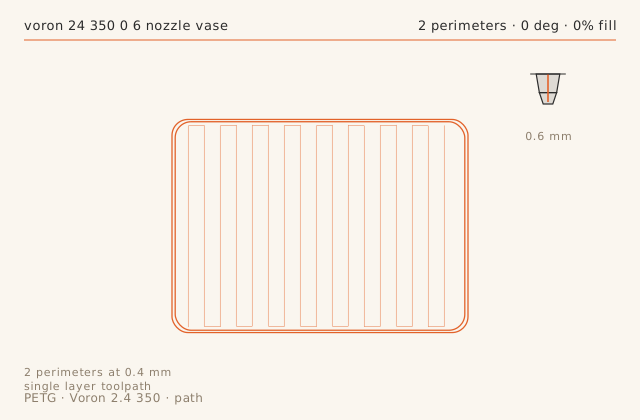
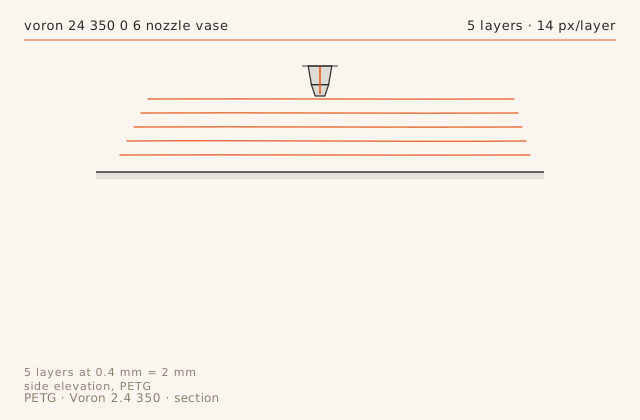
Slice diagramsDrawn from this entry’s own slicer settings.
Print record
- Machine
- Voron 2.4 350
- Material
- PETG
- Nozzle
- 0.6 mm
- Layer height
- 0.4 mm
- Walls
- 2
- Infill
- 0%
- Print time
- 1 h 27 min
- Published
- September 24, 2026
The volumetric speed ceiling is lower than the spec sheet says
A 0.6 mm CHT nozzle is rated well past 20 mm3/s, and at 0.4 mm layers and 90 mm/s this print asks for about 21.6 mm3/s. That number is achievable on a straight wall but not on a wall that is constantly changing direction, because the extruder has to accelerate and decelerate the flow with it. I capped the profile at 18 mm3/s and the horizontal seams every ten layers disappeared.
The general rule that came out of this: for vase mode, set your volumetric cap from a curved-wall test, not a straight-line test. The straight wall will pass a number the rest of the model cannot hold.
Wall thickness around the circumference is not constant
Measured at four heights and eight positions, the wall varied from 1.09 to 1.19 mm against a 1.2 mm target. The thin spots are where curvature changes fastest — the extruder accelerates, extrusion lags, and the wall thins. This is a pressure advance problem more than a flow problem, and raising pressure advance from 0.040 to 0.052 tightened the spread from 0.17 mm to 0.10 mm.
If the vase has to hold water, print it 0.05 mm thicker than you think you need and measure before you commit to a batch.
The neck-down is where cooling has to change
At 60 mm the profile necks in over about 15 mm. The wall there is unsupported in a way the cylindrical section is not, and at 80 percent cooling the plastic froze before bonding. Dropping to 60 percent cooling and slowing to 70 mm/s through that band fixed it. On a 0.4 mm layer height the thermal mass of each layer is larger, so it holds heat longer and needs less cooling than a fine-layer print would.
This also means vase mode on a 0.6 nozzle is not a universal speed-up: there are shapes where the slower 0.4 mm nozzle prints more reliably, just later.
When the big nozzle is worth it
For a decorative piece with no tight tolerance, the 0.6 mm nozzle at 0.4 mm layers cut this vase from an estimated 3 hours 20 on a 0.4 mm nozzle to 87 minutes, with a wall that feels substantially more rigid. For anything with a 0.2 mm tolerance or a fine surface detail, the same nozzle is the wrong tool and the finish will show layer lines the model does not deserve.
Swapping nozzles is a ten-minute job on this toolhead. The habit worth building is to decide by tolerance and surface, not by impatience.
Failure chainWhat went wrong, what was done about it, and what came out the other side.
-
Step 01
Symptom
Visible horizontal seams every 40 mm up the vase, at exactly layer height times ten.
Fix
The 0.6 CHT nozzle runs a long melt path. Dropped max volumetric speed from 22 to 18 mm3/s and added 0.4 mm of retraction-free coast at the seam start via vase mode smoothing.
Result
Seams reduced from clearly visible to detectable only by touch.
-
Step 02
Symptom
Vase collapsed inward at 60 mm where the profile necks down.
Fix
Part cooling was too high for the wall thickness at that point, freezing the plastic before it bonded to the previous layer. Reduced cooling from 80 to 60 percent and slowed the wall to 70 mm/s in that 15 mm band.
Result
Wall bonded correctly; the neck is now the strongest part of the print.
Dimensional check
- Feature
- 96 mm vase, wall thickness at four heights
- Nominal
- 1.2 mm
- Measured
- 1.14 mm-0.06
- Tolerance
- ± 0.08 mm
- Note
- Wall thickness varied 1.09 to 1.19 mm around the circumference. The thin spots sit where the profile changes curvature fastest and the extruder has to accelerate.
Slicer profile
printer_model: Voron 2.4 350
nozzle: 0.6 CHT
layer_height: 0.40
perimeters: 2, spiral vase mode
infill: none
speed: 90 mm/s
accel: 3000 mm/s2
nozzle_temp: 245
bed_temp: 80
part_cooling: 60%
pressure_advance: 0.052
max_volumetric_speed: 18 mm3/s
What carried over
- Set the vase mode volumetric cap from a curved-wall test, not a straight wall.
- Wall thickness varied 0.10 mm around the circumference after pressure advance was raised to 0.052.
- Neck-downs need lower cooling and lower speed than cylindrical sections.
- A 0.6 mm nozzle cut this 96 mm vase from about 3 h 20 to 87 minutes.
Verdict
The 0.6 mm nozzle is now the default for decorative PETG on this machine, with the profile capped at 18 mm3/s. Keep the 0.4 mm nozzle installed for anything with a tolerance callout.
Also on this machine Voron 2.4 350
-
Print log
A loose extruder latch cost 17 percent of the wall thickness and looked like a slicer problem
Intermittent under-extrusion with no pattern in the preview is almost never a slicer problem. This log is the diagnostic sequence that found it — measure the wall, measure the extrusion force, then adjust one thing at a time — and the narrow window between too loose and too tight on a Clockwork 2.
- MaterialPLA
- Nozzle0.4 mm
- Layer height0.2 mm
- Print time1 h 36 min
- Failure chain2
-
Tune profile
A PA6-CF profile for the Voron 2.4, and the two failures that dominate it
Carbon-filled nylon is the material where preparation matters more than settings. This is the profile that produced three consecutive clean three-hour prints: 285 C, no part cooling, 6 mm3/s, and a dry box on the machine at all times. It also covers the two failure modes that account for almost every bad PA6-CF print.
- MaterialPA6-CF
- Nozzle0.4 mm
- Layer height0.25 mm
- Print time2 h 58 min
- Failure chain2
-
Print log
Clearance coupons: finding this machine's real tolerance in one 64-minute print
Every FDM machine has a minimum clearance below which parts fuse, and it is not in any spec sheet. This log prints a six-clearance coupon, corrects the two slicer compensations that decide the answer, and settles on the numbers to design against on this specific Voron.
- MaterialPLA
- Nozzle0.4 mm
- Layer height0.2 mm
- Print time1 h 4 min
- Failure chain2