A PA6-CF profile for the Voron 2.4, and the two failures that dominate it
Carbon-filled nylon is the material where preparation matters more than settings. This is the profile that produced three consecutive clean three-hour prints: 285 C, no part cooling, 6 mm3/s, and a dry box on the machine at all times. It also covers the two failure modes that account for almost every bad PA6-CF print.
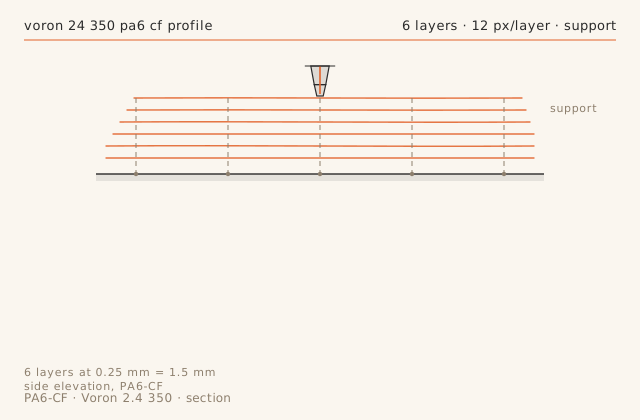
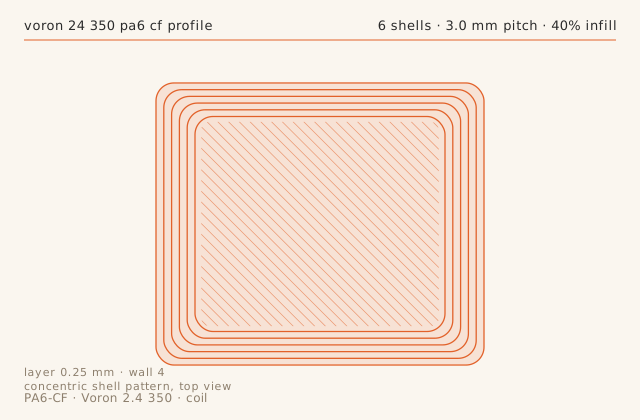
Slice diagramsDrawn from this entry’s own slicer settings.
Print record
- Machine
- Voron 2.4 350
- Material
- PA6-CF
- Nozzle
- 0.4 mm
- Layer height
- 0.25 mm
- Walls
- 4
- Infill
- 40%
- Print time
- 2 h 58 min
- Published
- October 8, 2026
Moisture is the whole game
A matt surface and layers that snap instead of bend are the signature of wet nylon, not of a wrong temperature. PA6-CF picks up moisture fast: two days out of a dry box was enough to halve the layer strength on this part. Dry 8 hours at 80 C, print straight out of a heated dry box, and treat a spool that has been open for a week as wet regardless of how it looks.
There is no setting that compensates for moisture. If the surface is matt, stop and dry the filament rather than raising the temperature, because raising the temperature on wet nylon produces steam-driven voids inside the wall.
No part cooling at all
This profile runs 0 percent part cooling. Nylon needs a slow, hot weld between layers, and a cooling fan quenches the top of the previous layer before the next one can bond. Above 10 percent cooling, 4 mm walls delaminated reliably in testing. The trade-off is overhangs above about 45 degrees, which come out rough; for those, either reorient the part or accept the roughness.
The chamber at 55 C does the work that cooling does on other materials. It slows the cooling rate so the part stays dimensionally stable without a fan.
The abrasive-filament maintenance bill
Carbon fibre wears the nozzle. On this machine the first 500 grams of PA6-CF opened the orifice enough that wall thickness fell from 1.05 to 1.00 mm, which is why the profile carries a 97 percent flow value rather than 100. Brass nozzles are consumed by this material in a few hundred grams; hardened steel or ruby is not optional.
Re-measure a 20 mm calibration wall every 250 grams of carbon-filled filament. When the wall drops more than 0.05 mm from the last reading, change the nozzle and re-run the flow test rather than chasing the flow number upward.
Retraction is a clog risk on a long melt path
At 1.5 mm of retraction on a 300 mm bowden-free direct drive with a long melt zone, molten PA6-CF gets pulled into the cold section and solidifies there. Two clogs in one print ended when retraction came down to 1.2 mm and travel speed from 500 to 300 mm/s. Nylon is stringy, so the instinct is to retract more — on a hot, long melt path that instinct is exactly wrong.
Accept some stringing and clean it off with a deburring tool. A part with a few strings is worth more than a part with a partial clog halfway through.
Failure chainWhat went wrong, what was done about it, and what came out the other side.
-
Step 01
Symptom
Surface was matt and the part snapped along a layer line when flexed.
Fix
Filament had absorbed moisture — it had been out of the dry box for two days. Re-dried 8 hours at 80 C, printed straight from a heated dry box.
Result
Surface went glossy and layer strength roughly doubled. The same part now bends instead of snapping.
-
Step 02
Symptom
Nozzle clogged 40 minutes into a 3-hour print, twice.
Fix
Retraction was 1.5 mm, which pulled molten PA6-CF up into the cold zone where it solidified. Reduced to 1.2 mm and lowered the travel speed from 500 to 300 mm/s.
Result
Three consecutive 3-hour prints with no clog and no partial blockage.
Dimensional check
- Feature
- 60 mm PA6-CF bracket, measured dry after 24 h
- Nominal
- 60 mm
- Measured
- 59.78 mm-0.22
- Tolerance
- ± 0.1 mm
- Note
- 0.37 percent shrink, stable across three repeats. Nylon absorbs moisture and grows about 0.2 percent if left out for a week, so this measurement is only valid on a dry part.
Parameter sweep
| Parameter | Tested | Chosen | Why |
|---|---|---|---|
| Nozzle temperature | 270 / 275 / 280 / 285 / 290 C | 285 C | Below 280 C the surface was matt and brittle at the layer lines. 290 C gave 15 percent better layer strength but the stringing was unmanageable on a 60 mm part. |
| Flow | 94 / 96 / 97 / 99 / 101 % | 97 % | PA6-CF is abrasive and the effective orifice wears; 97 percent held the wall thickness at 1.03 mm on a 1.05 mm target across a full spool. |
| Part cooling | 0 / 10 / 25 / 50 % | 0 % | Any cooling above 10 percent caused delamination on 4 mm walls. Nylon relies on slow cooling for interlayer welding. |
| Perimeter speed | 30 / 40 / 45 / 60 mm/s | 45 mm/s | The 6 mm3/s volumetric ceiling binds at about 50 mm/s with a 0.4 mm nozzle; 45 leaves headroom for acceleration. |
| Retraction | 0.6 / 0.8 / 1.2 / 1.5 mm | 1.2 mm | Below 1.0 mm the part had web strings on every travel; above 1.4 mm the nozzle clogged twice in one print from heat-creeped material being dragged back. |
Slicer profile
# LayerLog PA6-CF profile v2 — Voron 2.4 350, hardened 0.4 nozzle
# Filament must be dried 8 h at 80 C and printed from a dry box
nozzle_temp: 285
nozzle_temp_first_layer: 288
bed_temp: 100
chamber_temp: 55
part_cooling: 0%
layer_height: 0.25
first_layer_height: 0.30
perimeters: 4
perimeter_speed: 45
infill_speed: 90
solid_infill_speed: 70
travel_speed: 300
accel: 3000
pressure_advance: 0.058
retraction: 1.2 mm at 25 mm/s
max_volumetric_speed: 6 mm3/s
flow: 97%
brim: 8 mm
nozzle_material: hardened steel or ruby, brass will be destroyed
What carried over
- Dry PA6-CF 8 hours at 80 C and print from a dry box; wet filament halves layer strength.
- Run 0 percent part cooling; anything above 10 percent delaminates 4 mm walls.
- Carbon fibre wears the nozzle, so carry a 97 percent flow value and re-check every 250 g.
- Keep retraction at or below 1.2 mm on a long melt path or the nozzle will clog.
Verdict
This profile is reliable for structural brackets on this machine. It is also the most maintenance-heavy profile on the site: a nozzle check every 250 grams is not optional.
Also on this machine Voron 2.4 350
-
Print log
A loose extruder latch cost 17 percent of the wall thickness and looked like a slicer problem
Intermittent under-extrusion with no pattern in the preview is almost never a slicer problem. This log is the diagnostic sequence that found it — measure the wall, measure the extrusion force, then adjust one thing at a time — and the narrow window between too loose and too tight on a Clockwork 2.
- MaterialPLA
- Nozzle0.4 mm
- Layer height0.2 mm
- Print time1 h 36 min
- Failure chain2
-
Print log
Clearance coupons: finding this machine's real tolerance in one 64-minute print
Every FDM machine has a minimum clearance below which parts fuse, and it is not in any spec sheet. This log prints a six-clearance coupon, corrects the two slicer compensations that decide the answer, and settles on the numbers to design against on this specific Voron.
- MaterialPLA
- Nozzle0.4 mm
- Layer height0.2 mm
- Print time1 h 4 min
- Failure chain2
-
Print log
0.6 mm nozzle, 0.4 mm layers: what vase mode really costs you
A 0.6 mm nozzle on a Voron turns a 96 mm vase into an 87-minute print, but it also changes the failure modes. This log covers the seam artifacts that come from running a long-melt-path nozzle at high volumetric speed, and the one region of the model where cooling has to be handled differently.
- MaterialPETG
- Nozzle0.6 mm
- Layer height0.4 mm
- Print time1 h 27 min
- Failure chain2